Garbage Disposal Not Draining? Fix Guide | Tims Plumbing
Garbage disposal won't drain? Learn root causes, safe DIY fixes, and when to call a licensed Milwaukee plumber for fast, reliable repair.
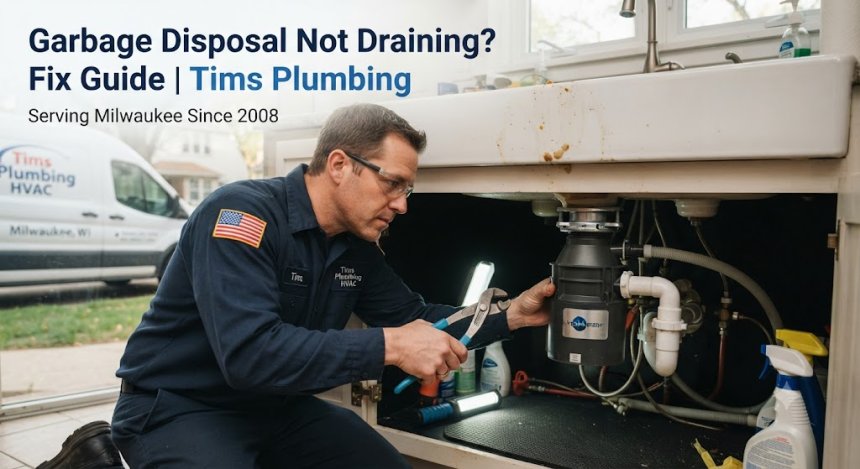
Standing in your kitchen with a sink full of murky water and food debris is a frustrating experience that instantly halts meal prep and cleanup. When you are dealing with a garbage disposal won't drain scenario, the temptation is to reach for a chemical bottle or force the switch repeatedly, which often exacerbates the issue. Homeowners across Milwaukee frequently encounter this during heavy holiday hosting or after rushing food scraps down the drain without enough water flow. Ignoring a sluggish or completely stagnant disposal can lead to foul bacterial odors, motor burnout from overheating, and backups that ruin cabinetry or subflooring. Local residents navigating Milwaukee's distinct seasonal shifts and municipal water profiles need practical, immediate strategies to handle these kitchen disruptions before they require costly emergency service.
What Is a Non-Draining Disposal? Decoding the Mechanism
A garbage disposal is not a blender; it uses centrifugal force and blunt impellers—not sharp blades—to grind food waste into fine particles that can safely pass through your home’s drainage system. When your system fails to drain, the problem usually stems from a blockage in the grinding chamber, the dishwasher inlet branch, the sink baffle, or the tailpipe leading down to the P-trap.
Imagine a typical Sunday evening in a historic Bay View bungalow: you scrape dinner leftovers into the sink, turn on the unit, and hear a dull hum followed by a complete stall. The grinding ring is choked with fibrous vegetable peels or expanding starches, trapping standing water that has nowhere to escape. Understanding that the motor and the drainage path are two separate physical zones helps clarify why a motor can hum happily while water remains trapped in the basin.
Root Causes: Why This Problem Occurs in Milwaukee Homes
Plumbing challenges are deeply tied to local infrastructure and environmental variables. Several regional factors contribute to garbage disposal and drainage failures in southeastern Wisconsin:
-
Hard Water Mineral Scaling: Milwaukee’s water supply carries high mineral content. Over time, calcium and magnesium deposits coat the internal components of the disposal and sink tailpieces, narrowing the passage for food slurry.
-
Aging Infrastructure: Many homes in neighborhoods like Riverwest or Wauwatosa feature older galvanized steel or cast iron drain lines that have accumulated decades of internal grease and scale buildup.
-
Temperature Swings: Extreme winter freeze-thaw cycles can cause minor ground shifting around buried waste lines, occasionally altering the pitch of horizontal drainage pipes under the kitchen sink.
-
Improper Scraping Habits: Disposing of expanding foods like rice, pasta, potato peels, and fibrous celery down older model disposals creates dense blockages that standard impeller action cannot break down.
-
Grease Congealing: Pouring warm cooking fats down the drain causes them to solidify rapidly as they hit cold Milwaukee tap water, binding food particles into a concrete-like plug.
Critical Warning Signs: When Your Home is Sounding the Alarm
Catching a failing disposal early prevents total system breakdown. Pay close attention to these warning indicators:
-
Auditory Clues: A sharp metallic rattle indicating foreign objects like silverware or bottle caps trapped in the chamber, or a low humming sound signaling a jammed flywheel.
-
Sensory Alerts: A persistent sulfurous or rotting odor emanating from the sink flange, caused by trapped organic matter decaying underneath the rubber splash guard.
-
Hydraulic Feedback: Gurgling sounds in the adjacent dishwasher or secondary sink basin when the disposal runs, signaling restricted venting or downstream line resistance.
Failing to address these signs allows stagnant moisture to warp cabinet bases, breed harmful mold spores, and invite pests.
Professional Diagnostic & Repair Workflow
When you call a licensed professional to resolve a stubborn kitchen drainage failure, they follow a methodical, safety-first procedure:
-
Step 1: Non-Invasive Triage & Safety Isolation: The technician shuts off the electrical breaker to the unit and tests the system control switches to ensure zero energy hazard.
-
Step 2: Precision Diagnostic & Digital Video Inspection: If the clog extends past the unit, miniature high-definition cameras are fed down the tailpipe and P-trap to locate the exact obstruction.
-
Step 3: Transparent, Upfront Options & Written Estimating: The plumber outlines whether the unit requires unjamming, seal replacement, or a complete system swap, providing clear flat-rate pricing before starting work.
-
Step 4: Code-Compliant Remediation & Part Replacement: The technician clears the blockage, rebuilds faulty connections, and ensures proper high loop configuration for the dishwasher drain line.
-
Step 5: Pressure Testing, Flow Verification, & Clean: Water is run at high volume while checking for leaks, verifying proper motor rotation, and sanitizing the work area.
Advanced Diagnostics: The Professional Tool Arsenal
Licensed plumbers rely on specialized equipment far beyond standard household pliers and wrenches to diagnose complex sink drainage issues:
-
Push-Rod High-Definition Drain Cameras: Flexible fiber-optic cameras that reveal root intrusions, grease buildup, or structural offsets deep inside branch lines.
-
Electronic Pipe Locators: Transmitters paired with surface receivers to pinpoint the exact underground or behind-the-wall location of a broken drain line.
-
Digital Manometers: Precision tools used to test branch line pressure and identify hidden venting restrictions.
-
Commercial Hydro-Jetting Units: High-pressure water descaling machines that scour interior pipe walls clean of decades of mineral and grease accumulation.
Financial Breakdown: Cost Factors & Investment Realities
Plumbing repairs involve variable cost inputs depending on the scope of work. Understanding what drives pricing helps property owners budget effectively:
-
Diagnostic Dispatch Fees: Standard service call charges covering travel and initial troubleshooting time.
-
Hardware Accessibility: Tight cabinet configurations or custom farmhouse sinks require extra labor hours to dismantle safely.
-
Material Selection: Replacing a standard 1/2-horsepower unit versus upgrading to a heavy-duty 3/4 or 1-horsepower stainless steel continuous-feed model.
-
Code Upgrades: Bringing older Milwaukee home wiring or slip-joint drainage configurations up to current municipal plumbing codes.
Unique Expert Insights: Hard Truths Homeowners Learn Too Late
-
Chemical liquid drain openers rarely clear organic disposal jams; instead, they sit in the standing water, eat away at rubber gaskets, and create hazardous splash-back risks when manually plunging.
-
Reset buttons on the bottom of disposal units are thermal circuit breakers; if a unit trips repeatedly, forcing it to restart without clearing the mechanical jam will fry the motor winding permanently.
-
DIY plastic replacement traps purchased at hardware stores often lack proper slope or slip-joint alignment, leading to slow chronic leaks that silently rot kitchen subflooring.
-
Home warranty policies frequently deny claims on garbage disposals if improper installation or foreign object damage (like utensils) is identified during inspection.
-
Installing a disposal without a properly positioned dishwasher high loop allows contaminated sink water to backflow directly into your dishwasher basin.
DIY Reality Check: What You Can Safely Fix vs. When to Step Back
Homeowners can safely handle basic troubleshooting steps before calling for help. Always ensure the wall switch is off and the unit is unplugged before looking inside the chamber with a flashlight—never use your bare hands to dislodge debris. You can use a wooden spoon handle or an Allen wrench in the hex socket at the bottom of the motor housing to manually rotate and free a stuck flywheel, followed by pressing the red reset button.
Step back and call a professional immediately if you notice electrical sparks, persistent burning plastic odors, cracked metal housings, or water leaking actively from the motor body itself. Attempting to rewire electrical connections or force corroded PVC slip joints under pressure risks severe water damage and safety hazards.
Comprehensive Home Plumbing Maintenance Framework
-
Spring & Summer Maintenance: Inspect outdoor spigots for winter damage, test sump pump operation before heavy seasonal rains, and check exterior property grading to ensure water flows away from foundation walls.
-
Fall & Winter Preparation: Disconnect and store garden hoses, insulate exposed basement pipes near exterior foundation walls, and flush the water heater tank to remove sediment buildup.
-
Year-Around Habits: Always run cold water for 15 seconds before and after operating your garbage disposal, use sink strainers to catch coffee grounds and eggshells, and avoid pouring grease or starchy waste down the drain.
Emergency Protocol: When Immediate Dispatch is Non-Negotiable
Certain plumbing events require immediate emergency dispatch regardless of the hour:
-
Active structural flooding threatening living spaces or electrical panels.
-
Complete main sewer line backups forcing raw sewage up through floor drains or lower-level fixtures.
-
Total loss of functional water supply across the property.
-
Major pipe bursts discharging high volumes of water behind walls or beneath flooring.
Frequently Asked Questions (FAQs)
Why does my garbage disposal hum but not spin?
A humming sound means the electrical motor is receiving power, but the grinding flywheel is jammed by a foreign object, food debris, or corrosion. Unplug the unit and use the hex wrench slot underneath the motor to manually turn the blades free.
Can I use liquid drain cleaner when my disposal won't drain?
No. Chemical drain cleaners pool inside the disposal chamber and can splash back dangerously when you attempt manual repairs. They also corrode metal grinding components and degrade rubber seals.
How long does a standard garbage disposal last?
Most quality residential garbage disposals last between 8 to 12 years, depending on usage frequency, water hardness, and maintenance habits.
Is it cheaper to repair or replace a broken garbage disposal?
If the motor housing is leaking water or the internal motor has burned out, replacement is almost always more cost-effective and reliable than attempting internal part repairs.
Why is water leaking from the bottom of my disposal?
Water leaking from the base of the unit typically indicates an internal seal failure within the motor housing. Once the main shaft seal fails, the unit must be replaced entirely.
What foods should never go down a garbage disposal?
Avoid potato peels, celery, corn husks, coffee grounds, eggshells, grease, rice, and pasta, as these expand or create fibrous mats that choke drainage lines.
Should I run hot or cold water when using the disposal?
Always run cold water. Cold water solidifies fats and grease so the disposal can chop them into small particles before they travel down the pipe as semi-solid mass.