Unclog Kitchen Sink Standing Water: Expert Guide
Learn how to safely clear a kitchen sink with standing water. Expert guide by Tims Plumbing HVAC for Milwaukee homeowners. Fast, reliable solutions.

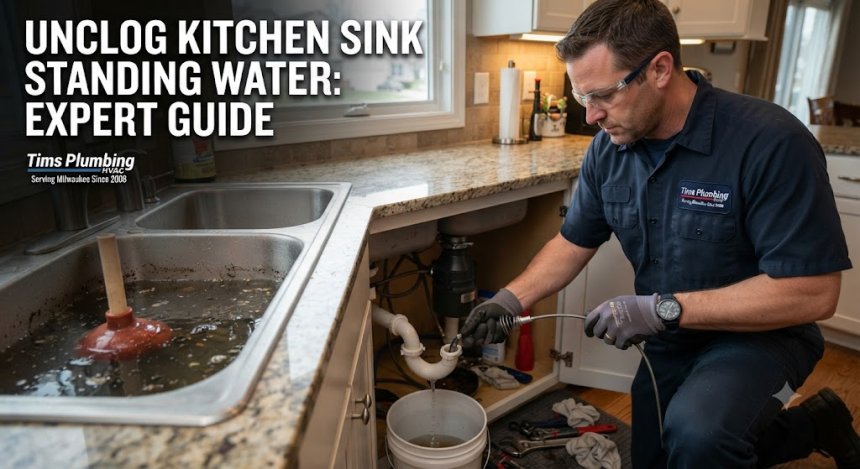
Standing water pooling in your kitchen sink is more than a mild kitchen inconvenience; it is a disruptive household emergency that brings meal prep and cleanup to a screeching halt. When you look down at unclogged kitchen sink standing water, you are staring at a trap full of decomposing food waste, grease, and bacteria inches away from your clean dishes. Milwaukee homeowners frequently face this issue due to the heavy use of garbage disposals during harsh winters and the unique mineral composition of our local municipal water supply. Ignoring this standing pool will not make it drain magically. Instead, the pressure builds within your drainage lines, risking under-sink cabinet leaks, mold growth, and unsanitary wastewater backup onto your kitchen floors.
What Is Kitchen Sink Drainage Failure? Decoding the Mechanism
Kitchen drainage relies on gravity, proper venting, and a smooth path from the basket strainer through the P-trap down into the main sanitary sewer line.
-
The Ideal Flow: When functional, water and liquefied waste plunge past the P-trap—which holds a small water barrier to block sewer gases—and exit smoothly through the vertical sanitary tee and branch lines.
-
The Failure Mode: When organic buildup, congealed fats, or structural blockages occur, the kinetic energy of the water meets a wall. Because water is non-compressible, it backs up vertically into the lowest available basin, creating an unyielding pool of standing water that refuses to vent or drop.
-
Local Context: In older Milwaukee neighborhoods like Bay View or Riverwest, historic multi-story homes often feature complex, multi-fixture sanitary tee configurations where a kitchen sink shares a vent stack with a bathroom, compounding back-pressure issues during a clog.
Root Causes: Why This Problem Occurs in Milwaukee Homes
Kitchen sink blockages rarely happen overnight. They are the result of cumulative physics and environmental factors unique to our region.
-
Aging Infrastructure: Many homes built in the mid-20th century or earlier still utilize aging cast iron or galvanized steel drainage pipes. Over decades, interior pipe walls develop rough, scaled corrosion—known as tuberculation—that catches grease and food particles like velcro.
-
Hard Water Mineral Scaling: Milwaukee’s water draws heavily from Lake Michigan, carrying moderate mineral hardness. Calcium and magnesium ions bind with soap scum and organic residue inside pipes, narrowing the interior diameter year after year.
-
Seasonal Temperature Shifts: During bitter Midwestern winters, subterranean ground shifts and freezing temperatures around shallow or poorly insulated exterior walls can cause subtle pipe misalignments, creating a lip where debris snags.
-
Improper Disposal Habits: Disposing of starchy pastes (pasta, rice, potato peels) and high-fat oils (bacon grease, butter) into the garbage disposal creates a concrete-like sludge once it cools in the underground drainage runs.
Critical Warning Signs: When Your Home is Sounding the Alarm
Long before a sink fills completely with stagnant water, your plumbing infrastructure provides distinct sensory warnings.
-
Auditory Cues: Listen for persistent gurgling noises when the dishwasher drains, or a strange whistling sound as air struggles to escape through a narrowing pipe opening.
-
Olfactory Indicators: A foul, sulfurous, or earthy odor rising from the drain indicates decomposing organic sludge trapped in the P-trap or main branch line.
-
Multifixture Interference: If flushing a toilet or running the washing machine causes water to bubble up into your kitchen sink, your main sanitary line is compromised, threatening catastrophic structural flooding if ignored.
Professional Diagnostic & Repair Workflow
Licensed, insured master plumbers do not guess; they execute a repeatable, non-destructive workflow to locate and resolve drainage failures efficiently.
-
Step 1: Non-Invasive Triage & Safety Isolation: Technicians evaluate the scope of the backup, place protective floor coverings, and ensure electrical safety around garbage disposal switches.
-
Step 2: Precision Diagnostic & Digital Video Inspection: A flexible push-rod camera with a self-leveling HD head is fed directly through the cleanout or P-trap to visually identify the exact nature and location of the obstruction.
-
Step 3: Transparent, Upfront Options & Written Estimating: The homeowner is shown live footage of the pipe interior, followed by clear, flat-rate pricing options for mechanical snaking, hydro-jetting, or pipe repair.
-
Step 4: Code-Compliant Remediation & Part Replacement: The blockage is cleared using commercial-grade tools, and any degraded P-traps, slip joints, or tailpieces are replaced to current Wisconsin plumbing codes.
-
Step 5: Pressure Testing, Flow Verification, & Clean: Multiple gallons of water are run through the fixture at high velocity to verify full laminar flow and ensure zero leaks under the basin.
Advanced Diagnostics: The Professional Tool Arsenal
Clearing stubborn standing water requires specialized equipment that far outperforms consumer plungers or chemical bottles.
-
Push-Rod HD Drain Cameras: These fiber-optic systems pinpoint exact distances and structural defects (like bellied pipes or root intrusion) underground.
-
High-Pressure Hydro-Jetters: Operating at 1,500 to 4,000 PSI, hydro-jetters scour grease, scale, and root mats completely off the interior walls of the pipe, restoring 100% of the internal diameter.
-
Motorized Drum and Sectional Augers: Heavy-duty steel cables with specialized cutting heads chew through dense clogs, hairballs, and hardened mineral deposits with precision torque.
Financial Breakdown: Cost Factors & Investment Realities
Plumbing repair pricing reflects the labor expertise, equipment deployment, and material quality required to solve the issue permanently.
-
Service Dispatch & Diagnostics: Standard diagnostic fees cover travel, time, and camera deployment to assess the problem accurately.
-
Clearing Method Complexity: Simple mechanical snaking of a P-trap is far less resource-intensive than hydro-jetting a main sanitary branch blocked by decades of scale and grease.
-
Accessibility Challenges: Clogs located in finished basements, behind drywall, or beneath concrete slabs require specialized access ports or excavation, impacting labor time.
-
Fixture Upgrades: Opting to replace an aging, rusted cast iron sanitary tee or install a modern PVC assembly adds modest material costs but prevents future failures.
DIY Reality Check: What You Can Safely Fix vs. When to Step Back
-
Safe Actions: You can safely bail out excess standing water using a bucket and cup, check the physical alignment of the P-trap slip nuts by hand, or test a manual garbage disposal reset button located underneath the motor housing.
-
The Danger Zone: Never mix chemical drain cleaners with mechanical tools or plungers, as splashed caustic fluid can cause severe chemical burns to your eyes and skin. Avoid forcing rigid metal coat hangers deep into wall tees, which can puncture older, thin-walled pipes.
-
When to Call a Pro: If standing water returns immediately after plunging, if multiple fixtures drain slowly, or if water begins backing up into your basement floor drain, drop the wrench and call a licensed professional immediately.
Unique Expert Insights: Hard Truths Homeowners Learn Too Late
-
Temporary grocery-store patch kits and rubber tape wrappers mask deeper system failures and can instantly void home insurance clauses if an undetected slow leak rots your subfloor.
-
Liquid chemical drain cleaners utilize harsh acids or lye that eat away at older metal pipe walls from the inside out, turning a minor clog into a costly pipe-burst emergency.
-
Unlicensed handymen frequently violate local plumbing codes by misaligning trap arms or omitting proper venting, leading to recurring foul odors and failed real estate inspections down the road.
-
Investing in routine preventive drain cleaning costs a tiny fraction of a single emergency midnight extraction and property restoration service.
Comprehensive Home Plumbing Maintenance Framework
-
Spring & Summer Maintenance: Inspect outdoor spigots for winter frost cracks, test your sump pump discharge cycle during heavy rainstorms, and verify exterior soil grading slopes away from your foundation.
-
Fall & Winter Preparation: Disconnect and drain garden hoses, insulate exposed basement pipes near exterior walls, and schedule a professional water heater flush to remove sediment buildup.
-
Year-Round Habits: Always use mesh sink strainers to catch food particles, run cold water for 15 seconds after turning off your garbage disposal, and completely avoid pouring cooking fats down any drain.
Emergency Protocol: When Immediate Dispatch is Non-Negotiable
-
Call an emergency 24/7 plumber immediately if you experience catastrophic main sewer line backups flooding your living areas or basement floor drains.
-
Immediate dispatch is required during active structural pipe bursts, total loss of clean water supply, or when overflowing fixtures threaten nearby electrical outlets and breaker panels.
Frequently Asked Questions (FAQs)
Can I use a plunger on a kitchen sink with standing water?
Yes, but with caution. If you have a double-basin sink, you must tightly seal the second drain with a wet rag or stopper so the pneumatic pressure forces the clog downward instead of blowing water out the opposite side.
Why does my garbage disposal hum but not spin when clogged?
A humming sound means electricity is reaching the motor, but an object or heavy grease has jammed the impeller blades. Turn off the power switch immediately and use the hex wrench slot underneath the motor housing to manually unjam the flywheel.
Are store-bought chemical drain openers safe for my pipes?
Generally, no. Caustic chemicals generate high heat that can warp modern PVC pipes and accelerate the corrosion of older metal plumbing, often hardening grease clogs rather than dissolving them.
Why is my kitchen sink backing up into the dishwasher?
The dishwasher drain hose typically connects directly to the garbage disposal inlet or the tailpiece above the P-trap. If the drain line is clogged, wastewater from the sink takes the path of least resistance right into the dishwasher tub.
How often should I have my kitchen drains professionally cleaned?
For standard households, having main kitchen and branch lines hydro-jetted or mechanically cleared every 2 to 3 years prevents catastrophic emergency backups.
What is hydro-jetting and is it safe for old pipes?
Hydro-jetting uses high-pressure water streams to scour pipe walls clean. A licensed plumber will inspect your pipe material with a camera first to ensure structural integrity before applying appropriate pressure.
Can tree roots invade kitchen drain lines?
While more common in main sewer lateral lines running to the street, aggressive root systems can exploit minor cracks in older exterior-bound kitchen waste pipes.